
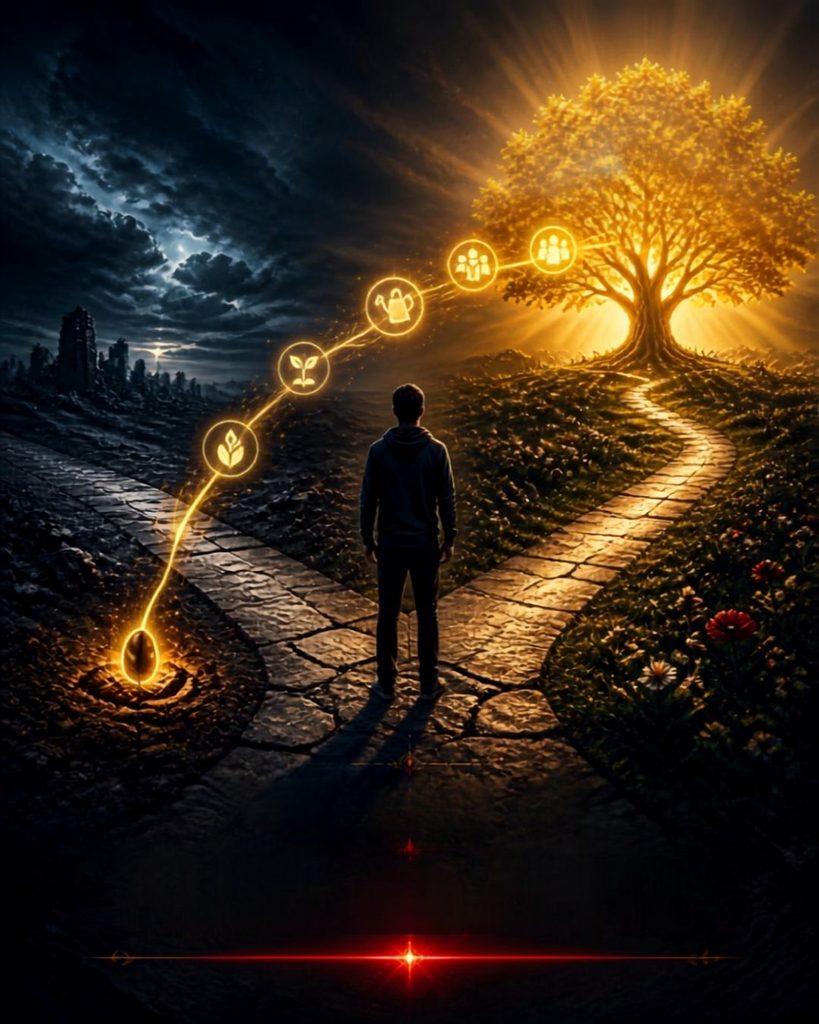
The Law of Cause and Effect states that nothing in your life happens by accident. Every circumstance you experience is the result of previous actions, thoughts, and choices. What appears random is, in fact, part of a precise universal mechanism where every cause produces a corresponding effect.
This principle, also known as the law of causality, doesn’t operate alone. It works in harmony with other universal laws, specifically the Law of Perpetual Transmutation of Energy, the Law of Compensation, and the Law of Vibration. Understanding what is cause and effect, and how these laws interconnect, reveals why your current reality reflects the energy you’ve been putting out.
Table of Contents
What is the Law of Cause and Effect
The basic principle of cause in effect
Causality is an influence by which one event, process, or state contributes to the production of another, where the cause is at least partly responsible for the effect, and the effect is at least partly dependent on the cause. In other words, the Law of Cause and Effect asserts that nothing simply ‘happens’ without a preceding trigger.
Every effect has a cause, and every cause necessarily leads to an effect...
This isn’t merely observation. It’s a foundational assumption that allows you to make sense of what would otherwise appear chaotic, transforming your world into a predictable system. Sometimes referred to as the ‘iron law of the universe’, the premise is simple: everything happens for a reason, there are no accidents, and you live in an orderly universe governed by natural laws.
The connection between cause and effect takes place in time, creating a continuous chain that has neither beginning nor end. If you continue to do the same things over and over again, you will get the same results. Your actions have outcomes, some intentional and some unintentional. The sum total of all these actions forms overall patterns that often drive the direction of your life.
How the law of causality works in daily life
Everything you do creates a consequence in your life. Take simple examples: if you choose to sleep in instead of getting up on time, you may be late for school. If you study hard and practice, you may do well on a test. Whenever you make a choice, even the smallest ones, there will be some sort of consequence.
The relationship between cause and effect can be straightforward like taking out an umbrella keeping you dry in the rain, or far more complex. Looking back at relationships, you might identify toxic patterns and the reasons why they caused unhappiness. There was a cause of those toxic relationships (your choice) and an effect (the toxicity).
Eating well, exercising, meditating, and relaxing seems to lead to many favorable consequences. Eating poorly, suffering stress, becoming a couch potato, and falling into various ruts seems to lead to many unfavorable, and sometimes life threatening, consequences.
Generally, you get out of life what you put in, and you reap what you sow…
Your thoughts as primary causes
Your thoughts are the primary causes of the conditions of your life. Everything in your experience begins with a thought of some kind, be that yours or someone else’s. Your thoughts can influence your physical and mental well-being, as well as your relationships, career choices, and overall happiness in life.
How you process a situation determines not just how that situation will turn out or the likely chain of events that will follow, but how you will interact with your family and friends, how much energy you will have for your work, and how motivated you will be.
Everything in your life is affected by the way you deal with your thoughts and the subsequent emotions and feelings.
You can identify when you are in a frame of mind that is likely to lead to negative outcomes. While you can’t filter thoughts and stop certain thoughts from happening, you can certainly learn to identify the thoughts that are helpful and conducive to happiness versus those that will only lead to further negativity.
How Cause and Effect Shapes Your Reality

Every action creates a ripple effect
When you drop a pebble into water, ripples spread outward, touching everything around them. Your actions work the same way. Every decision you make, whether big or small, carries the potential to create a chain reaction that extends beyond its initial occurrence. The impact may not be immediately visible, but over time, the ripples become more evident.
This ripple effect reveals the interconnectedness of your actions and behaviors with the world around you. Even small gestures, like showing kindness or sharing an idea, can grow into something bigger and more meaningful. Every single action you take has far-reaching consequences. You might help someone today, and that person might be inspired to help another, creating waves of positivity that reach people you’ll never meet.
Understanding this compels you to take responsibility for your choices. Recognizing that every decision impacts the lives of those around you means you must act with integrity and mindfulness. The law of causality doesn’t just apply to your immediate circumstances. It extends outward, creating ripples that shape the world beyond your direct awareness.
Your current life reflects past choices
Look around you right now. Your life at this moment is the direct result of all the choices you’ve made in the past. From your relationships to your career, from your health to your mindset, each aspect reflects previous decisions and actions.
Your past shapes your present and helps identify who you are and where you’re headed. The choices you make today are often influenced by past experiences. These experiences touch your life in ways you can’t yet fully comprehend, influencing the wiring in your brain. They shape how you perceive the world, how you respond to new experiences, and how fearful, confident, or bold you become.
Past experiences most definitely influence your choices, but you remain the decision maker. While pain or trauma from the past can impact how you view current circumstances, you have the power to break self-sabotaging patterns. The key is using healthy judgment to guide your choices, treating past regrets and mistakes as markers for what you don’t want in your life.
The connection between beliefs and outcomes
Your beliefs act as lenses that filter and shape your world. What you believe about yourself, others, and the world determines how you interpret experiences and respond to challenges. Beliefs predicate that particular outcomes will occur, dealing directly with causality.
Here’s the part that catches most people off guard: beliefs become self-confirming. When you expect failure, your behavior shifts accordingly.
For instance, someone convinced they lack good communication skills may stay silent in group discussions, missing opportunities to develop their abilities. This reinforces the original belief, creating a self-fulfilling cycle.
Beliefs hold power not because they’re necessarily accurate, but because they shape behaviors that perpetuate their perceived truth. Your beliefs become your reality. The world feels a certain way to you because your beliefs cause you to focus on specific things and act in ways that confirm those beliefs. When you change what you believe, you begin to transform who you are.
The Law of Cause and Effect and Related Universal Laws
Universal laws don’t operate in isolation. The Law of Cause and Effect functions within a broader framework of the 12 Universal Laws where multiple principles work simultaneously to shape your reality. Understanding these connections reveals how deeply interconnected your actions, energy, and outcomes truly are.
How it works with the Law of Perpetual Transmutation of Energy
The Law of Perpetual Transmutation of Energy states that energy is always moving, transmuting, or transferring, and it is in constant motion. Energy cannot be created or destroyed, but it can be transformed from one form to another. This perpetual motion directly supports cause and effect since every cause carries an energetic charge that inevitably becomes some effect.
Your thoughts perpetuate your energy. Given that you are the thinker of your thoughts, you possess the power to redirect energy by choosing better-feeling thoughts in any situation. When you shift your thoughts from negative to neutral, and then to positive territory, you transmute the energy within yourself. This transmutation becomes the cause that produces new effects in your life. Change your thoughts, change what you’re manifesting.
The link to the Law of Compensation
The Law of Compensation states that what you do affects what you get. You will be compensated for everything you do, including the effort you give, the actions you take, and how you feel. While the Law of Cause and Effect is the action taken to spark change, the Law of Compensation is the energetic return of those cumulative actions.
Your physical reality expresses your past actions and beliefs. Negativity breeds negativity, jealousy creates more jealousy, and healthy habits create a healthier life. The universe compensates you fairly for what you’ve put out into the world. By the same token, this operates without judgment, simply returning to you what matches your output.
Understanding the Law of Vibration connection
The Law of Vibration states that everything in the universe is in constant movement, vibrating at different frequencies. Your thoughts and feelings control your body’s vibration. Since everything vibrates, your emotional states dictate the frequency of your being, which sets up resonance with anything on the same frequency.
Vibration is what causes attraction. Your vibration becomes things, dictating what you draw into your life. You manifest what you’re a vibrational match for. This explains why cause and effect isn’t just about physical actions but about the energetic quality of those actions.
How the Law of Action supports cause and effect
The Law of Inspired Action states that for every action, there is an equal and opposite reaction. This physical principle is analogous to the Law of Cause and Effect. When two bodies interact, they exert forces on each other that are equal in magnitude and opposite in direction. Your actions create causes that show up as your reality, and for every action, there is a reaction.
Why Your Life Feels Random (But Isn’t)
Most people walk through life feeling like they’re at the mercy of random forces. Bad luck strikes. Good fortune arrives unexpectedly. Circumstances seem to control everything. This perception masks the law of causality at work beneath the surface.
The victim mentality trap
A victim mentality creates the illusion that life happens randomly to you. This mindset operates on three core beliefs: bad things will continue happening, others are to blame for your misfortune, and trying to change won’t work. At its core, this perspective stems from trauma or situations where you felt genuinely helpless.
The trap tightens when you adopt victimhood as part of your identity rather than recognizing isolated events where you were actually victimized. This shift converts what may have been a single setback into a permanent way of viewing yourself.
Consequently, you stop taking actions that could improve your situation because you’ve learned that nothing you do matters. Victim-sensitive individuals become less likely to trust others and more likely to behave uncooperatively, in particular during uncertain situations.
Unconscious patterns you’re repeating
Unconscious patterns are thoughts, feelings, and behaviors operating outside your awareness. They evolved early in life as coping mechanisms for overwhelming emotions. Because you can’t recognize them, you can’t easily stop them. They run quietly in the background, driving your actions without your knowledge.
These patterns repeat themselves across different situations. The physical circumstances change, but the emotional charge remains identical. You might find yourself in new relationships that mirror old dynamics or facing familiar work conflicts with different people. Your unmet emotions manifest as physical events that trigger those same feelings to surface.
External events vs. your response to them
External circumstances do influence your internal state, but they don’t control your response. When you can no longer change a situation, you face the challenge of changing yourself. Between any stimulus and your response exists the ability to choose. Something may influence your emotions, but it doesn’t have to control your actions.
You control how you interpret circumstances. The narrative you tell yourself about what happens matters more than the event itself.
Creating Intentional Causes for Better Effects

Understanding the law of causality means nothing without application. You shift from passenger to driver when you deliberately choose the causes you set in motion.
Taking ownership of your choices
Ownership puts you back in control of your life. When you accept responsibility for your role in outcomes, you gain the power to act differently moving forward. People who practice self-accountability achieve their goals more consistently than those who blame external factors. This shift transforms you from bystander to architect of your experiences.
Building habits that align with desired outcomes
Your brain forms new neural connections through repeated behaviors, making actions easier over time. Individuals who set specific goals are ten times more likely to succeed. Habits require between 18 and 254 days to develop, with 66 days being the average for automatic execution. Focus on fewer goals simultaneously to increase success rates.
Starting small to create big changes
Getting 1% better each day for one year makes you thirty-seven times better by year’s end. Small, consistent actions compound into significant results. When goals feel overwhelming, break them into micro quotas that feel almost too easy. Success at tiny tasks builds momentum for larger changes.
The role of consistency in manifestation
Daily practice solidifies changes in your neural circuitry. Without consistent action, old thought patterns persist. Progress matters more than perfection. Your manifestation routine must be sustainable even on your busiest days.
Let’s Get the Discussion Started
You’ve explored how the Law of Cause and Effect intersects with the Law of Perpetual Transmutation of Energy, the Law of Compensation, and other universal principles.
In reality, understanding what is cause and effect is one thing… living it consciously is another entirely.
Think about the patterns running your life right now. Which causes are you setting in motion without realizing it? Which effects keep showing up that you’ve been calling “bad luck”?
The law of causality doesn’t judge your choices. It simply reflects them back to you with perfect accuracy. Your thoughts create energy that transmutes into physical reality. Your actions earn compensation that matches their quality. Your vibration attracts circumstances that resonate at the same frequency.
Here’s what matters now: What’s one cause you’re ready to change today?
Maybe it’s a recurring thought pattern that keeps producing the same unwanted effect. Perhaps it’s a habit you’ve been meaning to shift. Or possibly, it’s a belief about yourself that no longer serves where you’re headed.
Drop your answer in the comments. Share which area of cause in effect feels most relevant to your current situation. Your insight might be exactly what another reader needs to hear right now.