
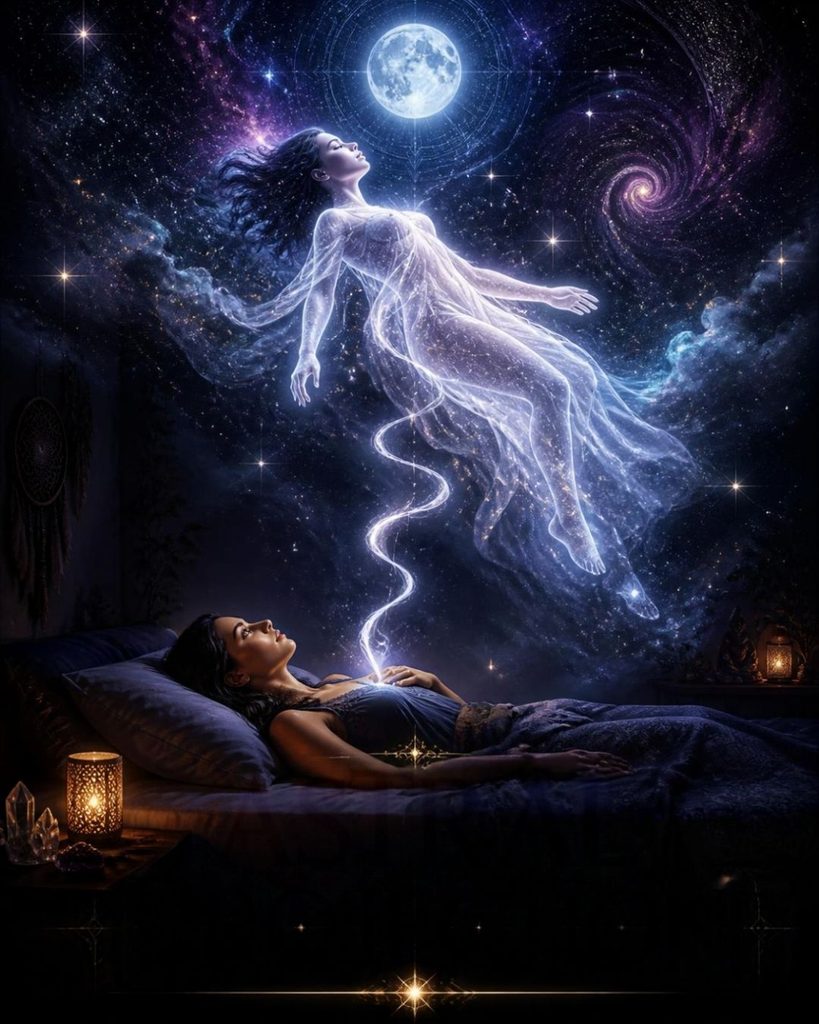
Astral projection is the experience in which consciousness separates from the physical body to travel through earthly and non-earthly realms.
For most people, this occurs naturally during sleep. The term itself was coined by 19th-century Theosophists to describe what they understood as an intentional out-of-body experience—one in which the astral body, or body of light, operates independently from physical form.
What astral projection means cannot be reduced to a single explanation. Personal testimonies speak of euphoric initial moments, while neurological research points to specific brain regions as the source of these experiences. Both perspectives reveal something worth examining. This article explores the core concepts behind astral projection, the documented evidence surrounding it, the practical methods used to attempt it, and—crucially—both the potential benefits and the psychological risks that come with it.
✨ What If Astral Projection Is Only the Beginning? ✨
What happens to consciousness when you enter that strange space between waking and dreaming? And what if experiences that seem impossible from an ordinary perspective are pointing toward a much deeper understanding of reality?
The Book of Wisdom Vol. 1 explores the mysteries behind consciousness, the illusion of separation, universal oneness, ancient symbolism, vibration, the power of the mind, and the possibility that reality is far more mysterious than we’ve been taught.
If you’re curious about what consciousness really is—and what may exist beyond the physical world—there’s much more to uncover.
Don’t stop at the experience. Explore the knowledge behind it.
Table of Contents
Understanding Astral Projection: Definition and Core Concepts
What Astral Projection Means in Simple Terms
Within esoteric traditions, astral projection is understood as an intentional out-of-body experience in which a subtle body—known as the astral body or body of light—operates independently from the physical form and moves through the astral plane.
Surveys suggest that between 10 and 20 percent of people report having experienced something resembling this state at least once in their lives. The essential feature of astral projection is not physical movement, but a shift in where consciousness directs its awareness—while the physical body remains completely still.
The modern understanding frames this as a process in which awareness becomes nonphysical: similar to tuning a radio to a different station. The physical data stream—the body in bed, the room, the weight of the body against the mattress gets muted.
What emerges is access to a different layer of reality. This distinction matters, particularly when comparing astral projection to lucid dreaming. Astral projection begins with the conscious act of leaving the body and perceiving it from outside; entities encountered in this state react to one’s presence, and the environment itself resists deliberate control.
The Astral Body vs. The Physical Body
Across traditions, the astral body carries many names: subtle body, dream body, energy body, tantric body. Webster’s Dictionary defines it as a subtle counterpart of the physical human body—one that accompanies it through life without typically separating from it, and that survives physical death. While residing within the physical form, the astral body assumes its same shape. Once separated, however, it can compact into a sphere—much like water takes the shape of its container but returns to a spherical form in the absence of gravity.
The astral body is the vehicle of feelings and emotions. Theosophy presents it as the third of seven bodies of man, capable of disengaging from both the physical and etheric bodies to travel independently through astral planes. It is this energetic body that animates physical life and moves freely through three-dimensional space.
Common Misconceptions About Astral Travel
Several assumptions about what astral projection requires simply do not hold. The conditions people believe are necessary are often more personal preference than genuine prerequisite:
- Dark rooms aren’t required: Astral projection can occur with lights on; darkness only aids those for whom it supports deeper relaxation
- Silence isn’t necessary: Audio environments—quiet or otherwise—are not prerequisites for reaching the vibrational stage
- Vibrations are optional: Though vibrations may signal the body preparing to project, they are not a requirement for the experience itself
- Timing matters differently: The most favorable window is after waking from insufficient sleep—not right before bed
Those who practiced astral projection across generations did so without modern tools, recordings, or aids of any kind. What the experience genuinely requires is relaxation and the willingness to remain aware while the body enters a sleep-like state. Everything else is secondary.
Can You Really Astral Project? Examining the Evidence

Personal Testimonies and Documented Cases
The question of whether astral projection is real cannot be answered without examining what people have actually reported, and what investigation of those reports has revealed.
One of the most cited cases occurred in 1977, when a patient named Maria at Harborview Medical Center claimed she floated outside her body during cardiac arrest and spotted a tennis shoe on a third-floor window ledge. Her social worker Kimberly Clark verified the shoe’s existence, and the case was widely presented as evidence of consciousness existing independently of the body.
Investigators in 1996, however, replicated the scenario and found the shoe was visible from inside patient rooms. Their conclusion: Maria had likely overheard a comment about it during her three-day hospital stay.
Survey data offers a broader picture. At the 1999 Barcelona consciousness research forum, 1,007 out of 1,185 respondents — 85% — reported having experienced an OBE.
Among those: 62% described nonphysical flight, 40% observed their own body from the outside, and 38% reported passing through solid objects. Notably, 45% stated they had successfully induced at least one OBE through a specific technique.
Recent qualitative research adds another layer. Ten participants interviewed in depth all perceived their experiences as authentic and distinct from dreams or hallucinations. Their explanations varied considerably: one attributed the experience to ketamine use, four offered no explanation at all, while five framed what happened through metaphysical concepts — universal consciousness, alternate planes, expanded awareness.
The experiences themselves were consistent. What they meant differed entirely depending on the consciousness observing them.
If consciousness can produce experiences that feel as though we exist beyond the boundaries of the physical body, an even deeper question emerges: Could consciousness survive the body itself?
For thousands of years, spiritual traditions have explored the possibility that consciousness doesn’t simply disappear at death, but continues through another existence. Reincarnation raises fascinating questions about past lives, soul memory, déjà vu, karmic patterns, and why some people report experiences that seem to transcend a single lifetime.
🔥 Ready to go deeper? Explore the secrets of reincarnation and uncover the mysterious theories surrounding what may happen to consciousness after death.
You may never look at life and death the same way again.
The Neurological Explanation for Out-of-Body Experiences
From a scientific standpoint, OBEs are attributed not to soul travel but to a temporary disruption in how the brain integrates sensory information. Research by Olaf Blanke in Switzerland identified the temporoparietal junction — the TPJ — as the region most directly involved.
Electrical stimulation of this area reliably produces OBE-like sensations in epilepsy patients. The TPJ is responsible for integrating visual, tactile, and vestibular signals to construct the brain’s sense of where the body is located.
When that integration fails, the sense of being inside the body fails with it. Studies link OBEs to a functional disintegration of multisensory processing — not to consciousness escaping matter, but to the machinery of perception momentarily losing coherence.
Henrik Ehrsson’s 2007 research at University College London demonstrated the first experimental method for inducing OBE-like states in healthy participants. These findings point to a clear neurological mechanism: mismatched sensory signals, not a departing soul.
What remains unresolved is whether that mechanism explains the experience entirely — or only the conditions under which it arises.
Cultural and Religious Perspectives Throughout History
Long before neuroscience had terminology for it, cultures across the world documented experiences of consciousness traveling beyond the body. The Inuit angakkuq reportedly journeyed to remote mythological places to heal the sick or improve hunting conditions. The Waiwai yaskomo performed soul flights to consult the Moon, seek abundant game, or receive guidance from river beings.
Hindu scriptures describe parallel states with considerable specificity. Ancient texts like the Yogavashishta-Maharamayana reference the Linga Sharira — a subtle body capable of independent travel. Paramahansa Yogananda documented witnessing Swami Pranabananda performing what appeared to be projection. The spiritual teacher Meher Baba explained that conscious separation of the astral body from the physical helps the soul distinguish itself from material form.
What these traditions share is a consistent framework: astral experiences are not random psychological events but learnable capacities of consciousness. This stands in direct contrast to Western scientific models, which classify them as dissociative states — expressions of a malfunctioning brain rather than an expanding one. Neither framework cancels the other. They describe the same territory from different levels of perception.
How to Astral Project: Techniques and Methods
Meditation and Relaxation Practices
Meditation is not a prerequisite for astral projection. Many practitioners reach out-of-body states without ever incorporating it into their practice. The paradox is this: when meditation is approached with astral projection as the goal, it ceases to function as meditation.
True meditative states arise through observation—noticing physical sensations and thoughts without judgment, returning attention to the breath between each observation. A subtle intention can be set beforehand, then released entirely during the session. The projection either comes or it does not. That openness is precisely what allows it to occur.
The Role of Sleep and Hypnagogic States
The hypnagogic state—the transitional zone between wakefulness and sleep—serves as the primary gateway for astral projection. Here, the mind retains awareness while the body enters sleep paralysis, creating the precise conditions for separation.
Attempting projection right before bed almost guarantees failure. Sleepiness overpowers intention. The more effective window is during waking hours or immediately after waking from four to six hours of sleep. The body holds slight tiredness while the mind remains alert—a delicate balance that makes separation possible.
Tools and Aids That May Help
Guided meditations and binaural beats support some practitioners, though they are not essential to the process. Two methods stand out for those beginning:
- The rope technique: Mentally reach upward and pull yourself out hand-over-hand, as if climbing
- The roll-out method: Imagine yourself rolling sideways off the bed, allowing the astral body to follow that movement
What to Expect During Your First Attempt
First attempts rarely produce full separation—and that is normal. Initial experiences manifest as small movements: gliding a few inches, or brief visual shifts at the edges of perception. Vibrations, buzzing, or tingling sensations commonly precede separation, though they are not mandatory.
The process unfolds gradually. The first weeks typically bring improved relaxation and occasional vibrational sensations, while weeks four through twelve tend to produce the first partial separations. Patience here is not passive—it is part of the practice itself.
The Reality of Astral Experiences: Benefits and Warnings
What People Report Seeing and Feeling
Accounts of astral projection vary widely, yet certain patterns appear consistently. The separation process produces sensations described as electric vibrations—heavy and dense when the emotional state is low, light and floating when there is inner calm. Some practitioners describe what can only be called pure bliss: a quality of relaxation and wholeness that surpasses anything the physical body ordinarily produces.
Visual experiences span the full range of possibility. Some report realms of extraordinary beauty that resist description. Others encounter dark, disorienting environments.
The astral space does not appear to be uniform—what one person experiences differs significantly from another, and even a single practitioner may encounter vastly different conditions across separate attempts.
Potential Benefits for Personal Growth
For many experiencers, astral projection produces effects that extend well beyond the experience itself. The most commonly reported outcome is a shift in how consciousness relates to physical existence—specifically, a diminished fear of death that arises from the direct sense that awareness continues beyond the body.
Other reported benefits include heightened spiritual awareness, access to symbolic representations of subconscious patterns, and encounters that some describe as contact with deceased relatives.
Studies show 55% of experiencers said their life changed, while 71% found lasting benefit. Additionally, 40% described it as the greatest thing that ever happened to them. Enhanced creativity, strengthened intuition, and a deeper sense of connection with something larger than the personal self also emerge as common outcomes. These reports suggest that, for many practitioners, the experience functions as a catalyst—not an endpoint, but a doorway into a more expansive relationship with consciousness.
The Dark Side: Dangers and Psychological Risks
Not all astral experiences are benevolent, and this dimension of the practice deserves honest attention. Some practitioners report encounters with shadow entities, presences that create intense physical pain, or experiences of being pulled into projection without consent. These accounts are not rare enough to dismiss.
Research links out-of-body experiences to higher rates of mental health concerns and childhood trauma, suggesting that for some individuals these states function as dissociative coping mechanisms rather than genuine expansions of consciousness. The consequences can be significant: unhealthy obsession with the practice, social isolation, disrupted sleep, and a growing disconnect from ordinary relationships and responsibilities.
There are also accounts of entities attaching during experiences, with effects reported to persist for months afterward. The practice, in other words, is not neutral. What is entered must also be navigated, and that navigation requires preparation.
When to Avoid Attempting Astral Projection
There are circumstances in which astral projection should not be attempted. People with anxiety disorders, schizophrenia, or dissociative conditions should avoid this practice entirely, as it carries a real risk of worsening existing symptoms. The same applies to anyone in a destabilized emotional state, under the influence of alcohol or substances, or approaching the practice without any form of experienced guidance.
Younger practitioners face particular challenges: the spiritual discernment required to navigate difficult encounters or recognize unwanted attachments develops over time and cannot be rushed. The practice rewards preparation, groundedness, and a clear sense of intention—not urgency or curiosity alone.
Let’s Get the Discussion Started
The boundary between consciousness and body remains one of humanity’s most compelling mysteries—and you might hold a piece of that puzzle.
Whether you’ve experienced a fleeting moment of separation during sleep, felt the unmistakable pull of vibrations as your awareness shifted, or simply find yourself drawn to these questions with an inexplicable curiosity, your perspective matters. This isn’t a conversation reserved for mystics or neuroscientists alone. Every experience—from the skeptic who dismisses it as brain chemistry to the practitioner who navigates astral realms regularly—adds depth to our collective understanding of what consciousness truly is.
What questions are stirring within you right now?
Perhaps you’re wondering: If consciousness can exist independently of the body, what does that reveal about the nature of death itself? Or maybe you’re more practically inclined: What was your first sign that separation was actually happening—and how did you know it wasn’t just a vivid dream?
For those who’ve attempted projection without success, what specific obstacle keeps appearing? Is it the inability to relax deeply enough, the fear that arises at the vibrational stage, or simply the question of whether you’re “doing it right”?
And here’s a question that bridges science and spirituality: If neuroscience can explain the mechanism behind OBEs, does that diminish their significance—or does it simply describe the doorway through which consciousness travels?
Share your story in the comments below. Whether you’re a curious skeptic with questions, someone who’s had an unexpected out-of-body experience, or a seasoned practitioner with insights to offer, your voice contributes to a larger conversation about the true nature of human consciousness.
Your experience—or your thoughtful questions—might be exactly what another reader needs to hear on their own journey of exploration.
What has astral projection taught you about yourself? What are you still trying to understand? Let’s explore this territory together.